Inventioneers Full Version
- 4.8
- Rating
- 10.00K
- Installs
- $5.99
- Price
 Analysis by App-foxy
Some puzzle games ask you to find the correct answer, while Inventioneers Full Version asks you to build your way toward one. My first impression was that it feels less like a worksheet disguised as a game and more like a small workshop where every failed idea is useful. The basic appeal is easy to understand: you create strange inventions, test them, and adjust them until the result works. What makes the experience memorable is the playful mood around that process.
This is an educational game from Filimundus AB, aimed at Everyone, and it suits children who enjoy making things as much as solving problems. I also found it surprisingly pleasant for an adult to explore alongside a child, because the challenges encourage discussion rather than simply rewarding fast reactions. It is available for $5.99, so it is not competing with free casual distractions on price alone. Its value depends on whether you want a hands-on puzzle experience with room for experimentation.
Inventing first, solving second
The game’s strongest idea is that the solution is not presented as a single path that must be memorized. You work with the available parts, think about what each piece might do, and then watch the invention behave. That creates a useful loop: observe the problem, form a guess, build something, test it, and revise the design. Even when the attempt fails, the result usually tells you something about timing, placement, or cause and effect.
You May Also Like

 Blood Strike: 2.5 Anniversary
Blood Strike’s Loadouts Turn Every Drop Into a Tactical Gamble
A close look at Blood Strike’s custom loadouts: how fast access to signature weapons reshapes its battle royale rhythm, rewards preparation, and narrows the gap between fights.

 Pandora - Music & Podcasts
Pandora’s Music Is Easy to Start, but Harder to Recover
Pandora’s strength is its low-effort path from a seed to a station. Its weak spot is how much confidence it asks you to place in connection, setup, and quiet recovery.

 8 Ball Pool
 Is Built on Rivalries, Rematches, and Routine
A close look at the rivalries, rematches, shared routines, and unanswered safety questions that turn a quick pool match into a persistent mobile community.

 Samsung Music
’s Quiet Strength Is Playing What You Already Own
Its reach comes less from spectacle than from dependable access to a personal library. That simplicity is both the app’s strongest retention engine and its ceiling.

 AccuWeather: Weather Radar
AccuWeather Review: A Quick, Clear Forecast for Everyday Decisions
For everyday plans, the best forecast is the one you can understand quickly. AccuWeather makes rain timing, radar, and local conditions easy to act on, with a few trade-offs.

 Hill Climb Racing
Why Hill Climb Racing Still Turns Crashes Into One More Run
A tiny car, a bumpy hill and one more upgrade: Hill Climb Racing keeps resurfacing because its simple chaos makes every near-miss feel personal.
More From Our News Desk



I like this approach for children who become frustrated by conventional educational games that feel like repeated quizzes. Here, the learning is embedded in the activity. A child may be thinking about balance, movement, sequence, or simple physical relationships without being asked to name those ideas formally. The game keeps the language approachable, which makes it easier to focus on the experiment itself.
That does not mean every player will enjoy it equally. A child looking for constant action, rapid rewards, or a clearly marked route may find the slower construction process less exciting. The game expects curiosity and patience. It works best when the player is allowed to try something slightly ridiculous instead of being pushed immediately toward the intended answer.
A visual world built around playful logic
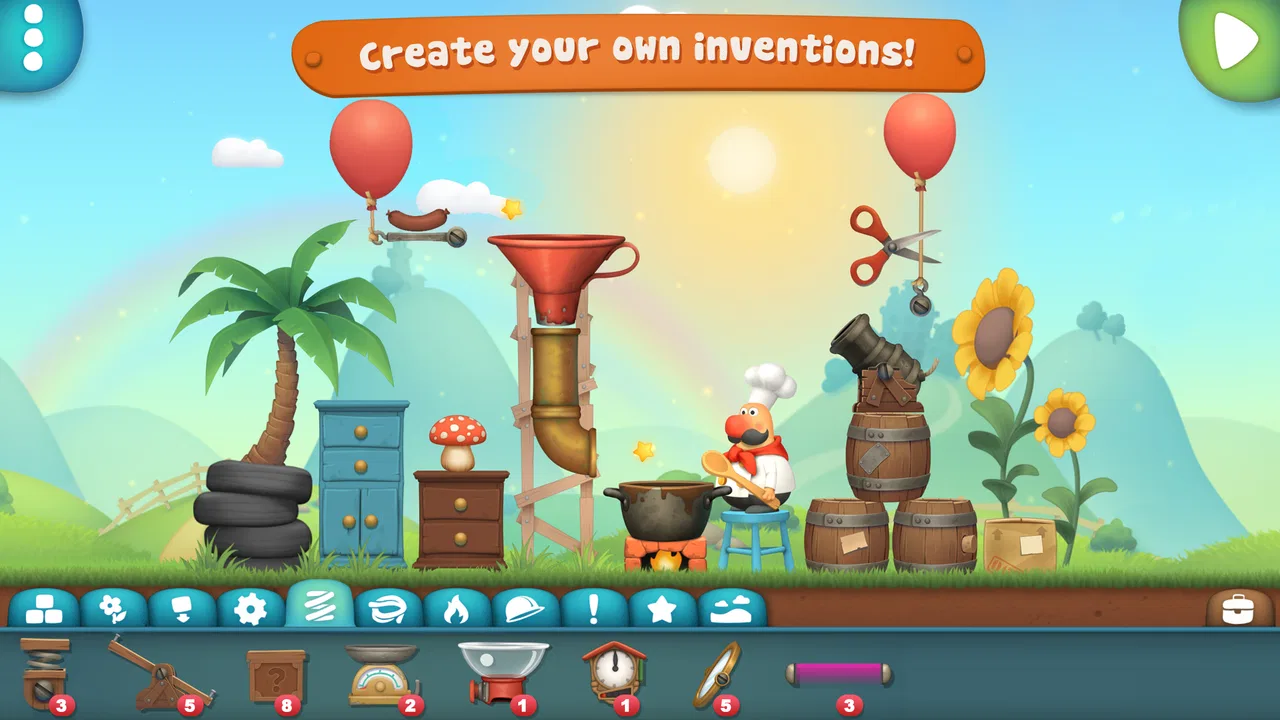
The art direction supports the central idea without overwhelming it. The setting feels like a friendly invention space rather than a realistic laboratory, and that distinction matters. The visual language gives permission to be imaginative. Objects look like parts of a toy-like machine, so experimenting with them feels natural instead of intimidating.
I found the presentation especially effective because it keeps attention on the relationship between objects. The important question is not whether a component looks impressive on its own, but what happens when it interacts with another component. That makes the screen feel readable during a puzzle. A younger player can concentrate on the moving parts and the outcome instead of sorting through a busy interface.
The cheerful presentation also prevents failure from feeling too serious. When a construction does not work, the mood remains light enough to encourage another attempt. That is an important design choice in an educational game: the visual tone makes trial and error feel like part of the activity rather than evidence that the player is bad at it.
There is a trade-off here. Players who want a deep story, a large character-driven world, or dramatic visual progression should look elsewhere. The setting exists to support invention puzzles, not to deliver an elaborate narrative. I think that focus is appropriate, but it means the game’s charm depends heavily on whether you enjoy its workshop-like atmosphere.
Why the sound matters more than expected
The sound design works as a quiet partner to the visual style. It helps give movement and completion a sense of rhythm without turning the game into a noisy arcade experience. That restraint suits the puzzles. I can imagine using it in a shared room or during a calm play session without the audio becoming the main event.
What I appreciate most is the way sound reinforces the feeling of cause and effect. A machine that behaves as expected feels more satisfying when the audio confirms the result, while an unsuccessful attempt still belongs to the same playful world. The sounds do not need to explain the puzzle in words; they help the player notice that something has happened.
The pacing benefits from this balance. The game gives the player time to inspect a problem and think before testing a design. It is not constantly interrupting the process with long explanations or dramatic scenes. For a child, that creates a comfortable rhythm between concentration and discovery. For an adult helping nearby, it also leaves room to ask questions such as, “What do you think will happen if we move that part?”
That calm rhythm can feel slow if you approach the game expecting instant stimulation. I would not choose it as a quick reflex game for a short burst of high-energy entertainment. Its appeal grows when the player has enough attention available to watch an invention operate and consider why it succeeded or failed.
Where the mechanics and mood meet
The mechanics fit the tone because building is not treated as a separate menu activity before the “real” puzzle begins. Construction is the puzzle. The player’s decisions have visible consequences, and that makes the educational side feel practical rather than decorative. Instead of selecting an answer from a list, you create a small explanation through the invention itself.
One useful way to play is to resist rebuilding everything after a failed attempt. I recommend changing one element at a time whenever possible. If you move several parts at once, you may get a successful result without understanding why it worked. Adjusting a single part turns each attempt into a clearer experiment and helps children connect an action with its consequence.
Another good habit is to ask the player to predict the result before testing. This turns passive trial and error into a simple scientific routine: make a prediction, observe the outcome, and compare the two. The game does not need to announce that lesson for it to be valuable. The structure naturally supports it, especially when an adult gives the child time to explain the idea in their own words.
I also think the game is well suited to shared play between siblings or a parent and child, but only if the older player avoids taking control. It is tempting to solve a difficult construction quickly, particularly when the intended solution seems obvious. Doing so removes the most valuable part of the experience. A better role is to point out what changed, ask what the player noticed, and let the child perform the next test.
This is where the game differs from many ordinary puzzle apps. A typical logic title may reward identifying a rule and applying it cleanly. Inventioneers rewards understanding a system through manipulation. That makes it more open-ended in feeling, even when a puzzle has a particular goal. Compared with drawing apps, it also provides more structure: the player is not only making something attractive but trying to make it behave.
Compared with coding games, the experience is more immediate and physical. There is less need to learn a formal programming language before seeing an outcome. That makes it approachable for younger players, although a child who specifically wants text-based coding, character commands, or a larger programming curriculum may eventually need a different kind of app.
Practical fit for families and classrooms
In everyday use, I see this working well during a quiet afternoon when a child wants something interactive but the parent does not want another purely competitive game. A parent can sit nearby, let the child lead, and use the inventions as conversation starters. “Why did that part move?” and “What could we change first?” are more useful prompts than simply asking whether the puzzle was solved.
It can also fit a short shared session, because a player can focus on one construction at a time rather than needing to commit to a long story chapter. Still, I would not describe it as a background game. The player needs to watch what happens and think about the result. It is better for deliberate play than for keeping a child occupied while nobody is paying attention.
For classroom use, I would treat it as a discussion tool rather than a complete lesson by itself. The game can provide a concrete starting point for conversations about prediction, sequence, movement, and design. An educator could ask students to describe their first attempt, identify the change that mattered, and explain why the final construction behaved differently. The educational value comes from the reflection around the game as much as from the interaction on screen.
The age rating of Everyone makes the presentation broadly accessible, but that does not mean every puzzle will be equally easy for every child. Younger players may benefit from an adult explaining the goal in plain language, while older children may enjoy being challenged to find a more efficient or surprising approach. The same activity can therefore work at different levels, provided the helper adjusts the questions instead of giving away the answer.
On the technical side, the current version is 4.1.8 and requires Android 6.0 or later. That makes checking the device’s operating system an important step before paying, particularly if the game is intended for an older tablet. I would also decide in advance whether the price fits your family’s use: at $5.99, it makes more sense as a focused educational purchase than as an impulse download to sample for five minutes.
Who will enjoy it, and who should pass
I would recommend it to children who like taking objects apart mentally, building unusual combinations, and seeing immediate consequences. It is especially suitable for a child who asks how things work or who enjoys making a toy behave in an unexpected way. The game gives that curiosity a clear direction without forcing the player into a rigid academic format.
It is also a good choice for parents looking for an activity they can discuss with a child. The best moments are not necessarily the successful ones. A failed invention can lead to a better conversation because it gives the player something concrete to inspect. That makes the game useful for practicing patience and explanation, not just puzzle solving.
I would skip it for someone who wants a free-form construction sandbox with no goals at all. The game provides problems to solve, so the creativity is guided by objectives. I would also choose another option for a player who needs spoken instruction, a strong narrative, or fast action to stay engaged. Its gentle pace and workshop setting are strengths for the right audience, but they are also clear boundaries.
Adults should keep expectations realistic as well. This is not a complete science course, and it should not be judged by the depth of a traditional educational curriculum. Its learning comes from manipulating systems and talking through outcomes. If you want detailed lessons, formal progress tracking, or a broad subject syllabus, a dedicated learning platform may be a better fit.
What the reception suggests
The game has a 4.8 average from around 135 ratings, with about 20 written reviews, and it has passed 10K+ installs. Those figures suggest a small but strongly positive audience rather than a mass-market action hit. I read that as a useful signal for this particular kind of game: people who connect with the inventive puzzle format seem to value it, while its focused nature naturally limits its reach.
The developer, Filimundus AB, has positioned the experience around playful creation rather than competitive pressure. That identity comes through in the way the setting, sound, and mechanics support one another. Nothing feels designed to make the player rush through the invention process. The game wants the player to notice, test, and try again.
That coherence is more important than having a huge number of separate features. The art makes experimentation feel friendly, the sound gives outcomes a sense of rhythm, and the mechanics turn curiosity into action. When those elements work together, the educational purpose feels like a natural result of play rather than a label attached afterward.
My final take on the workshop mood
After spending time with it, I see Inventioneers Full Version as a thoughtful choice for families who want puzzles with a creative, hands-on character. Its best quality is the way it makes failure productive. You are not merely told that an answer is wrong; you are encouraged to look at what your invention did and decide what to change.
The atmosphere deserves equal credit. The friendly art direction keeps the world approachable, the sound supports the movement without dominating it, and the measured pacing gives the player room to think. Those choices would mean little without the building mechanics, but together they create a consistent mood: curious, playful, and calm enough for real learning.
At $5.99, I would recommend it when you are specifically looking for a paid educational game that a child can explore independently or with an adult conversation around it. I would not buy it for fast action, elaborate storytelling, or unlimited sandbox construction. For the right player, though, it offers something more valuable than a quick distraction: a small place where strange ideas can be tested until they start to make sense.
FAQs for Inventioneers Full Version
01What is Inventioneers Full Version?
Inventioneers Full Version is a physics-based puzzle game focused on building creative machines to solve increasingly complex challenges. You combine objects such as fans, ropes, wheels, balloons, and other interactive parts to guide characters or move items toward a goal. The game encourages experimentation, so there may be several possible solutions rather than only one correct construction.
02Is Inventioneers Full Version suitable for children?
The game is generally suitable for children, families, and players who enjoy logical problem-solving without fast action or complicated controls. Its colorful presentation and playful physics make it approachable, while later puzzles require patience and planning. Parents should still check the current store listing for age ratings, advertising, in-app purchase details, and any privacy information before allowing younger children to download it.
03Does Inventioneers Full Version work offline?
Most of the core puzzle experience can usually be enjoyed without a continuous internet connection, which makes Inventioneers convenient for travel or areas with unreliable network access. Internet access may still be required for downloading the game, receiving updates, restoring purchases, or using optional online features. Availability can vary by platform and version, so confirm the latest requirements on Google Play or the App Store.
04How difficult are the puzzles in Inventioneers Full Version?
Inventioneers starts with simple construction tasks that explain how its objects and physics behave, but the difficulty gradually increases. Later levels may require several mechanisms to work together and often reward testing, timing, and creative thinking. If a solution fails, experimenting is part of the intended gameplay. Players who prefer quick, straightforward puzzles may find some stages demanding, while fans of sandbox-style challenges will likely enjoy the freedom.
05What should I know before downloading the full version?
Before downloading, verify that your device meets the current Android or iOS requirements and has enough free storage for the installation and updates. Also check whether the version offered in your region is a paid download, includes optional purchases, or differs from a trial edition. The full version is most appealing to players who want access to the complete puzzle experience rather than only a limited selection of introductory levels.
Pros
- Creative physics puzzles encourage experimentation and problem-solving.
- Full version provides access to the complete puzzle collection.
- Inventive contraptions make each level feel different and rewarding.
- Simple controls are approachable for younger and casual players.
- Offline play makes it suitable for travel or areas without internet.
Cons
- Some solutions require trial and error rather than clear logical steps.
- Later levels can become frustrating without hints or repeated attempts.
- The visual style may feel dated on newer phones and tablets.
- Limited replay value after all puzzles have been completed.
- Certain device screens may make small interactive parts hard to select.

Inventioneers Full Version
Gallery